Showing posts with label scotland. Show all posts

Thursday, 10 July 2008

A week in Scotland Travelogue: caressing the White Rose DAY II (Part II)


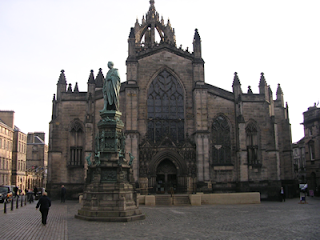
The open space in front of St Giles entrance, facing uphill, is occupied by the statue of Sir Walter Scott, and I take a few minutes to enjoy a smoke under its shadow, remembering the great times I had reading the adventures of heroes like Ivanhoe or Quentin Durward. What I did not know, until I got to Edinburgh, was his important social and political influence in the country, widely commemorated. Near his statue a brass heart is engraved in the cobblestones, which, according to tradition marks the location of the Tollbooth, official building that served as administration centre, executions place, prison and tax collecting office. The outline of the building, demolished in 1817, is also marked in the ground. Traditionally you are meant to spit inside the Heart
for luck, but the origins of this superstition are not very clear and seem to spring from multiple sources. As for myself, I am aware of a few traditions in my own country that are frowned upon by local people so, seeming this (a spit) the kind of gesture that can be interpreted in many different ways, I decide to bide my time and find out some more about it, as I will have plenty of time to pay my humid homage. Nevertheless I make a mental note to watch the wind and other bystanders next time I walk by, and to never pick up a coin or paper if I was to drop one there in the future.
Many souvenir shops start appearing on the right hand side, as I continue up and leave George IV bridge to my left, entering the stretch of Royal Mile known as Lawnmarket. There is this freaky side to me concerning movies and subcultures, and ever since I saw Highlander I have had the impression that I would look pretty good in a kilt or tartan. Better a tartan, but I get the feeling that this is the most expensive option. Now, the typical highlander outfit is really the tartan, a colour patterned (the word tartan is also used to refer to the patterns, though the right term is sett) stretch of woven cloth rolled about waist and shoulder. The kilt is an invention (by an Englishman no less!) adapted past the XVIII century, when highlander culture was vindicated after a long period of prosecution. It was also more or less at this time when patterns started to define clans, rather than regions (many setts were made up at that moment). So I do some investigation around the shops, realizing, to my dismay, my budget will not allow for a kilt, much less a tartan. It is impossible to find a low to medium quality kilt for less than 30 pounds, and that is a lot of money for me. There are kilt like towels, but I will rather return in a more wealthy future and get the real thing. One of the shopkeepers has a kind of Hispanic accent to his English and for a millisecond I embrace the fantasy of a fellow Spaniard offering me a big discount. Upon asking I find out he is from Argentina. Close, but no cigar. I will stick to sightseeing and leave shopping for now.
For a while now, during my stroll uphill, my eyes have been often drawn to a long blackened spire that towers above all central Edinburgh and whose base I am reaching at this moment. It is The Hub, home and tickets office to the Festival of Edinburgh and some other festival in the cities, formerly St John’s church, built in 1842 and Assembly Hall for the Church of Scotland until the 240 feet high landmark was closed for religious use in 1929, and the Assembly moved to Greyfriars Kirk. The Royal Mile is getting steep in this last stretch, but I can already see the esplanade of the castle, and it is all I can do not to make a run for it, leaving, by the entrance to the esplanade and to my right, the Camera Obschura, an outlook tower that contains a funfair of light and mirrors illusions and effects, many focused on the city around, providing spectacular sights of Edinburgh (entrance fee is included in the Edinburgh Pass, 8 pounds otherwise, discounts for children, senior, students, and disabled visitors).
It is 10:30 am and the sun is shining (rare in Edinburgh) over the huge space before the Castle. Some minutes to enjoy a cigarette and walk around, admiring the views to the city, left and right, and take pictures. To the right/north the New Town, the Nor Loch gardens down below the crag, with a gigantic spire that dwarfs the Hub (the Scott Monument, a gracious gentleman points out) just alongside them, and beyond, the Firth and the sea. On this side of the esplanade stand a few monuments in memory of soldiers fallen, again, in the Great War. There are many like these in Edinburgh, including the Memorial that occupies one of the main buildings of the Castle. To the left, South Edinburgh, including most of the middle wealth range residential areas and, beyond, the tranquil landscape of the Lothians. A couple of landmarks attract my attention from here. The first one, right on front of me and below, is a castle like construction surrounded by a nice garden that I recognize at first glance as a very exclusive, old fashioned institution for young students. It brings to my mind the name of Eton School, where James Bond studied according to his literary father Ian Fleming. Later on a local guide will tell me how my shot did not fall far off the mark: apparently, one of the possible inspirations for Fleming’s character could have been an acquaintance of the author, a Scottish Intelligence officer whose name I don’t manage to retain, that had been educated at this institution: Heriot School. Curiously enough, one of the first jobs of Sean Connery when he was young was milkman of that area, delivering part of their breakfast daily to Heriot students. No further investigation on my part, however, has produced any other evidence or suggestion of a Heriot educated Bond’s inspiration.
The other landscape feature I feel drawn to is some steep hill standing just west of town: it has a kind of personal charisma, and in think I can see tiny spots of movement on the summit; one of the security guards tells me it’s called Arthur’s Seat, a popular spot for easy trekking. I am using the word “easy” somewhat loosely here, as I am anything but athletic and quite on the heavy side. Still, that connection with the Arthurian legend, first (and only) I find in Scotland, draws me. My eyes keep staring at it. Nay, I will have a stroke before I get midway to the top. Get it off your head boy.
Time to visit the Castle proper. The entrance fee is pretty expensive (11 pounds, only discounts for children) but visiting is something I don`t like to spare money on. Later (too late always) I will find a way to enter the Castle for free: all you have to do is go up to the guards at the gates and say that you want to pay homage to the War Memorial (you may say you are of Scottish ancestry, or have friends of Scottish ancestry who had someone in the fight…). It may take some insisting, but apparently they have let you in. They may let you go by yourself or they might give you escort. Either way, the memorial is at the very top, and you have to go through most of the Castle to get to it, so you will have a very good look at it. You will not be able to access the interior of the buildings, though, unless they let you go alone (and even if they do so, you know you are not meant to visit the other buildings, right?). Goes whithout saying, this hint is offered with my uttermost respect for those remembered at the Memorial.
Crossing the gates, guarded by the stone visages of Rober the Bruce and William Wallace, a steep wide road leads spiralling up, through the portcullis to the highest point of the complex. At a calm pace it takes me the best part of two hours to visit the Castle, the Memorial, prison, dungeons and the tower where the Stone of Destiny (or Stone of Scone, after the Abbey of Scone, where it was kept in medieval time) and the Jewels of the Scottish Crown (Crown, Sword and Scepter) are kept. The Stone is a block of sandstone over which every king and Queen of Scotland swore their oaths in old days. Abducted by the English, the Stone, also used for coronation of British rulers, was kept in Westminster Abbey for centuries, and suffered a rescue attempt in Christmas 1950, an eventful adventure in the process of which it was dropped by the rescuers and broken in two pieces, took a ride in the back of a borrowed car the keys of which were later lost by the abducters (the stone still inside), spent a night of pagan celebration and partying with some sympathising college students in Ilkley moor and was finally left in a Scottish abbey, I believe by the Perthshire area, in the hope that the Church of Scotland would protect it. Apparently when the poor abbot saw what had been left in his church and realised the trouble he had gotten himself into, he called the Scottish police, who, not knowing really what to do, called Scotland Yard in turn and they finally recovered the item, after what I imagine a long succession of “you have found what?”’s at the phone. A local tells me that when the Stone was finally given back to Edinburgh and brought to the Castle, not long ago, they played the soundtrack of “Mission: Impossible” during the parade. Isn’t that great? I love Scottish sense of humour. On my way back out I make another stop by a balcony with awesome views of the New Town and the Firth, alongside a battery of old cannons. From here I get my first good view of Calton Hill, west of New Town, another popular landmark of Edinburgh: it is a small hill on top of which are assembled a few constructions of neoclassical style, included a Parthenon-like one, which are one of the reasons why this city is dubbed “The Athens of the North”. To the left of the old cannons there is a modern one, nick named the “One O’clock cannon”, as it shoots every day at that time. I would like to see it, but it is still 12:30 and I am not good at waiting. Last thing I do is having a look over the balcony at a small pet cemetery two meters below, where the soldiers best friends rest in peace (part of the Castle are military facilities and barracks).

Read More...

Wednesday, 9 July 2008

A week in Scotland Travelogue: caressing the White Rose DAY II (Part I)


I make an early (for me) start at 8, in order to make most of the day, and I go out into the street intending to find a pub and wolf down a huge breakfast complete with bacon, eggs, sausages, etc. I walk up Grayfriars to the Royal Mile and stop to gaze upon Edinburgh in daylight for the first time.
Espectacular. Up to present date Edinburgh is the most beautiful city I have had the honour to visit. The decadent buildings, crammed to each other, crowned by rows of old looking chimneys, look taken right out of a tale, and every façade has its own architectural charisma. Blackfriars opens onto the stretch of Royal Mile called High Street, roughly by its middle point. A few feet uphill, an avenue crosses from New Town north to the south of the city, partly made up of what once was the Edinburgh Bridge. To the north, spanning the difference in height between the hill and New Town and passing by the Balmoral hotel (the most luxurious, decadent and historical hotel of the city) and its typical five minutes fast watch, this avenue is called (admittedly) North Bridge, while to the South of Edinburgh, South Bridge maintains the only open arch that remains of the bridge, above Cowgate, and finally becomes, past the University area and the Surgery School with its sinister stories of bodysnatching, Nicholson Street. My first sun lighten steps through the Old Town take me uphill, towards the Castle.
Right by the corner of the bridge stands one of the evoking stone needles that scrath the air from the steets of Edinbugrh: the Tron Kirk (kirk:church) in present times home to the Old Town Informaiton Center. Its name derives from an old measuring device for weighing salt that was found outside the building in old days (from the old French “Tronel” or “troneau”, which means scales or balance). Built in 1648, the stone needle is actually two centuries older, built after the Great Fire of 1824 burned away a previous wooden tower. Nowadays there exists a polemic project to mutate the building and the adjacent space of Hunter Square into a kind of restaurant and club. I admire the style and lines of its blackened walls and continue my way some feet up the street to the Mercat Cross.
The Mercat Cross is a conjunction of pulpit and balcony, hexagon planned, which used to serve multiple functions. The present construction dates from 1885 and uses some elements from the original one from 1615. Aside from being the main meeting point in town, where newcomers would turn to hire the services of a cadie (yes, this is is the origin of the term used in golf) to carry his belongings and guide him around, most mercantile contracts were sealed under its shadow and all kind of official announcements were made from its balcony. However, its most renowned use is, probably, that of gallows and place of public execution.
The history of the city has a sinister side which is exploited to good profit by the tourism industry. One of the elements that are part of this dark face is a long list of examples of the administration of justice in medieval times. Credit where credit’s due, one must concede the Scottish society of the day an impressive creativity in certain things. For a start, they invented the guillotine much earlier than the French: a very similar device called The Maiden shared with the axemen the work of beheading highborn (this method was usually reserved for noblemen) transgressors. According to some sources the maiden was not nigh as sharp as its French counterpart, sometimes resulting in, how to put it, somewhat unhygienic messes (curiously enough Edinburgh’s Maiden was stored in the Cathedral, so much for harmony and peace of spirit, mine is the vengeance, claimed the Lord!); on the other hand, the axeman was not free of error: some registers of the time describe how Mary Queen of Scots took three blows of the axe before the executioner could raise his terrible trophy, circumstance this that was not unusual. Most common criminals were hanged, or sometimes drowned (often used for women, this method); for particularly hideous crimes (“hideous” in a political context, i.e. killing someone important enough, even if you did so clean and vicelessly) no expenses were spared: some David Hackstone, charged with murdering a bishop during the religious conflicts of the Reform, was executed along a period of three days. First his hands were cut by the wrists. Then his feet were severed by the ankles. After that he spent the night on top of Mercat Cross, recovering. Next day, his arms and legs were tied behind his back to the gallows, with a rope not long enough for him to reach the ground, and thrown down (see, Scots also invented Bunjee jumping!), so all his joints yanked out of place. There was still sunlight, so he was thrown down a couple of times more (no rope this time, to hit the ground) to make most of the day, and was left a second night at the Cross. The third day the executioner tore out Hackstone’s pulsing heart from his ruined but still living body and showed it to the crowd (an estimated 40.000 people used to attend executions, just like a rock show nowadays) shouting “See the heart of a traitor!”. After that, just to be on the safe side, he was hanged, and cut in pieces that were sent to different parts of the country. Cool, huh?
It is 08:30 and I am very hungry, but in the pubs I have tried the kitchens will not start serving the big breakfasts until 09:00, so I walk back to my hostel, where, at the reasonable (for Edinburgh, I mean) price of 3 pounds, I can prepare myself a treat with six items out of all the possibilities offered (scrambled eggs, sausages, beans, haggis, tomatoes, bacon and more). I choose two portions of scrambled eggs, two sausages and two slices of bacon. Tea, coffee, toasts, butter, etc are complimentary. Three toasts and a tea will do. Mmmmm. Much better. You just can’t find these kind of spiced pork sausages in Spain, after Marks and Spencer retired from the European market, and I miss them to tears. Satiated, I continue my visit of the Old Town.


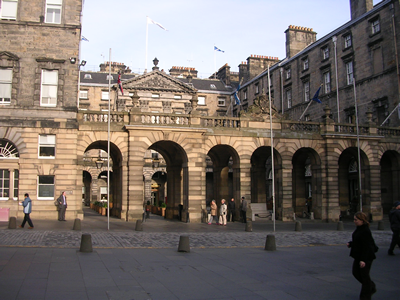
In front of Mercat Cross I find the City Chambers, official building that rests atop what once was Mary King’s Close. All homes in this close, during the plague, were walled and sealed with their inhabitants still alive inside. As it happened, their ghosts (this people can´t take a joke) got a bit miserable about it and it is said they still roam the place, which claims to be the most haunted spot of the U.K (then again, it’s not the only one to claim that title). One of the walking tours involved in the supernatural side of Edinburgh organizes visits to Mary King’s Close.
By the sidewalk outside the chambers there are a few stalls selling souvenirs and jewellery. It turns out a couple of the keepers are Spanish. The girl I cross a few words with confirms our presence in the city.
“Gibraltar may be British…” She says, smiling “… but Edinburgh is ours!”
Next to their stall has its own a lady that claims the Guiness Record of highest number of piercings in the face. Takes me just one look to decide that I believe her, and I don’t look close.
Back across the street and next to the Mercat Cross stands St Guiles Catedral (still coming by the title of Cathedral although it is not one anymore). The exterior shows a beautiful gothic style, with elegant flying buttresses around the apse and the dome. Inside, the main naves are not particularly impressive, but his walls are soaked in history and dozens of plaques pay tribute to those fallen in the Great War, while the bearded statue of John Knox, father of the Religious Reform, stands vigilant to one side. His body lies close by, albeit outside the walls. Much more striking is the adjacent Thistle Chapel (symbol of the most noble knighthood order of Scotland) which, to the right of the apse, contains a kind of round table and a choir with beautiful carvings. It is, I have it, one of the only two places in the world where you can find a piper angel.


Behind this building is the old Scottish Parliament, rendered useless when the Parliaments of England and Scotland were united in the XVIII century. It is curious to find, in the space between Cathedral and Parliament, now a parking lot, a little bronze plaque in the pavement, with nothing engraved on it. John Knox wanted specifically to be buried there, so when the kirkyard was removed from that place, his body was the only one that stayed. Since that space has, in time, been needed as parking space for the Old Parliament, it turns out that the main architect of the Scottish Reform rests in peace under lot 23. Definitely striking.

Read More...

Tuesday, 8 July 2008

A week in Scotland Travelogue: caressing the White Rose DAY I

Not much to tell about the flight, apart from some minor setbacks and delay in boarding our plane; flying with a low cost airline these things do not catch me unaware. Already inside the boarding finger and the gate open, they take us out again and walk us around the airport, changing our boarding gate yet another three times. We all take it lightly, some jokes, some more patience, and there we go. Flight is about 2 ½ hours long and crew and commander provide a goodhearted easy going attention, seasoned with some light well taken humour; only my own eagerness to reach Scotland makes the journey feel a little longer than it is: will it meet my expectations? After all the years passed since I last went on a trip like this, how will the backpacking experience turn out? Will I be able to make the most of it?
As soon as we land I direct my steps to the Tourist Info Office in the airport. Aside from collecting my Edinburgh Pass (a card that, during 1, 2 or three consecutive days provides access to several activities and attractions in the city, as well as to the Lothian buses network, and a range of special offers and discounts), I intend to gather some information on the possibilities for some day trips from Edinburgh. Behind the counter, my attention is drawn by a huge picture of the typical Scottish castle, by the typical Scottish lake, amid the typical Scottish low range mountains. It is hard to resist, and feels very familiar. I play the smart ass and produce the first castle name that springs to my mind from reading my guide:
“That is Urqhart’s Castle (one by Loch Ness), right?”
The girl smiles patiently and corrects my mistake (big mistake, by the way, Urqhart and this castle are nothing alike, as I will have the chance to confirm myself)
“Nay, this is Eilean Donan. It features in a few important movies, you might recall it from “Highlander”.
Riiiiight. Of course I knew I had seen it before. The girl looks down to the Lonely Planet guide I am carrying: “Escocia” and asks if I am from Spain. On my affirmative response, she welcomes me in perfect, Madrid native, Spanish. I read the name in her id tag: “Belén” (absolutely Spanish name). Well, what do you know!
Actually it should not be surprising, as I learn later: 20.000 people in Edinburgh, out of a 400.000 population, are Spanish. That is a 5 per cent, not bad at all!
I tell Belen my poorly planned itinerary, I am open to suggestions, and, sure enough, fifteen minutes later I have cancelled my reservation in the hostel of Glasgow for the weekend, and have arranged a place in a 3 days, 2 nights tour to the Isle of Skye, with McBackpackers.com (apart from this and some other tours for backpackers they run a range of hostels around Scotland) The price is 79 pounds, accommodation not included (13 pounds night, to be paid on spot on arrival to the hostels) Wow. I have just arrived and my expectations are literally booming!
Belen is from Madrid (if I recall right) and has been living in Scotland for the past five years. Though she loved it from the start, she misses Spain and is planning her return. She gives me some suggestions about what to see and do in town. Very quick, as I have to catch the bus downtown, I am already somewhat behind schedule. Following her indications I find the stop for the Airport Link Bus (5 pounds return usual fare, included in the Edinburgh Pass I just collected) and make the 25 mins journey to the very centerspot of downtown Edinburgh: Waverley Bridge. Downtown Edinburgh is comprised by the Old Town, perched on the hill and crested by the medieval castle, and the New Town, built in Victorian style by the feet of the hill when (after English and Scottish governments were united and living within the old walls was no longer a tactic need) town was enlarged, tackling a very serious problem of overpopulation. Both the main train station, Weaverley, and mentioned Weaverley Bridge, stand in the middle of both areas, in what was, in its day, the Nor Loch. When you exit Weaverley station, or drop off the airport bus, you stand thus under the huge basalt crag over which the Old Town climbs, admiring a spectacular view. If you arrive by day, that is.
I arrive late, however, night stealing such welcome from me. All cats are black at night, as you know, and I am little disoriented. I get directions from the bus driver and make my way up the steep Cockburn street to the spine of the hill and the old quarter which clings to the line of the main avenue, the Royal Mile that joins the Castle on top of the crag with Holyrood Palace at its base, following the backbone of the hill. This main street also comes by other names in its different strands: Castle Hill, High Street and Canongate. In the time it takes me to reach my hostel, for which I have to ask several people (navigating Edinburgh is dead easy, I must say, and I reach my goal in just a few minutes), a particular aroma starts envolving my nostrils. One of Edinburgh’s oldest nicknames is “Auld Reekie”; it comes from a time in which the city was gravely overpopulated and polluted, and the smoke from hundreds of chimneys mixed with the smells of non existing sanitary conditions and a terribly unhealthy and filthy environment. Now, this smell around me is neither unpleasant nor does it obey to such reasons. After some consideration I end up identifying it (or at least naming it, I do not know if my judgement is right) as smoked ham or maybe a combination of cooking odours in which smoked ham is predominant. The sense of smell is a very powerful suggestive which leaves very strong impressions in the mind. Through my life I have confirmed that, if most of our memories are made out of visual items, memories of these tend to turn diffuse with time, while a smell can suddenly awaken a torrent of very vivid images, sensations and feelings. I do believe that Edinburgh will always be associated, in my mind, to the smoked ham, just as Havana reminds me of the smell of Luzbrillante (the kerosene derived gas they use in Cuba), as Galicia in the north of Spain smells of sea to me, and as memories of England conjure up an aroma that I can not name but that I surely identify as soon as I get off the train in Victoria and walk the streets of London.
My hostel (SmartCity Edinburgh) stands in Blackfriars street, down the other side of the hill. It features the 5 stars quality mark of the Scottish Tourism Office VisitScotland. This mark does not define a category for services, but their quality levels within a given context; in this case it means that, for a hostel in which accommodation is shared in multiple rooms and for a price of (in that time, booked through VistScotland.com) 10 pounds per night, it is the best you can get, and I think the judgment is sound. The place is of very recent construction, and, although you share rooms, all have within shower and wc facilities (2 of each). All clean and well managed. 1,60 P for a washing machine and 20 pence for a 12 minute cycle of tumble drying. It also has a very well equipped common kitchen to prepare your own food, as well as a bar where you can buy breakfast, lunch or dinner. The common hall is ample and comfortable, with several low tables and sofas and a massive screen in which to watch tv and a dvd flick every now and then. Also two outdoor spaces with tables, chairs, and sunshades equipped with heaters for the cold (only places to smoke in the hostel). All in all, everything nice and well run, with young and friendly staff.
When I reach my room to leave my things I find the bed I had assigned, lower side of a bunk, is occupied. It doesn’t bother me, I will make it do with the top one. Let sleeping with the knowledge of having 250 pounds suspended over his head be punishment enough for the transgressor. He apologizes when he returns. Its OK. He is Australian, a decent chap. I already made my bed on top, so I stay there. The room is for 8 people but we are only four: the Australian bloke, a peculiar Scotch named Martin, a Chinese guy whose name I do not catch and myself. A quick shower and out for a walk, I am too excited to sleep.
Finding nightlife poses no difficulty: just as I round the corner by Cowgate (in other strands named Holyrood road, Grassmarket, West Port and East Fountain Bridge) I hear a Spanish couple chatting in a portal and I seek some advice. It turns out that in the very first street parallel to Blackfriars, Niddry St., there are a few pubs which feature live music shows. I take a look and decide myself for the Nicole Edwards, which boasts being haunted. Nicole Edwards occupies some locals (it actually comprises three small bars) which dig under the street, inside the Edinburgh Vaults (that I will explore more thoroughly next day), and that belonged, in old days, to a namesake confident of king James VI in the XVI century: a mean spirited character that sent his wife to die in a desert island for being insolent to him, and who, according to legend, hid a hoard of treasure (never found) within his property. The barman (huge guy, even broader than myself, looks like Hugo, from LOST tv series) tells me there is gig tonight, acoustic. Sounds cool. I decide trying yet another pub before the concert. Two doors up the street is Whistle Binkies, another popular live music featuring pub. Today, as all Tuesdays, is night for new bands. I have a pint while listening to SleazyCumEasyGo (yep, I swear that was the name of the band). Not very bad as music players go, but the actual songs, somewhere between punk and metal, do not impress me much, so I return to the previous pub. The Scots Bar within Nicole Edwards is small and comfy, and on the tiny stage Jaimie (a real beauty with a great voice) and Acoustic David (a likable uncouth dude with a great ability to alternate rock and pop classics, adding a few good laughs and not taking himself very seriously) are getting ready. Until 3 in the morning I enjoy the music, take care of 7 or 8 pints and, all in all, I manage to have a great time. Back to the hostel I somehow make it to the top bed of the bunk and fall asleep in seconds.

Read More...

Thursday, 10 April 2008

Backpacking in Scotland

Wages in Spain are not that good for the eleventh economy of the world (they are sad, actually), mine in particular, so when I managed a few days off last winter and I decided that I couldn’t wait more to see Scotland, I soon realised, on checking transport and hotel prices, that backpacking was my only option, at least if I intended to pay the rent and eat at least twice a day (I have weird habits, I like to eat everyday and have a roof under which to sleep regularly!) for the following months. So I called on one of my teenager brothers and asked for my old rucksack back, and prepared myself to discover exactly how old can being 31 years old and three stones heavier really feel when you go back to doing things the way you did them back when you thought yourself immortal. And I haven’t regretted that decision for a single moment. Oh, I felt, old, out of shape, heavy and broadly in need of medical treatment, but I loved every minute! I found Scotland (or what I saw of it) a great country to travel this way.

First thing to say is that Scotchs are a jolly good bunch: warm, good spirited and generous. I would say they probably are, along with Irish, French and Italians (in no particular order) the most similar to Spanish in their attitude towards life within Europe. And this is particularly important when you travel virtually penniless and short of luxuries and commodities: they try to make you feel at home.
Hostel accommodations in Scotland are aplenty, and for all reports I’ve gathered, pretty good in general. It is a popular destination among backpackers, so there is an important infrastructure which results in a very wide and varied offer to choose from: family owned, youth hostels, chains, YMCA’s, dorms… In Edinburgh in particular I would recommend Macbackpackers chain from reports of many travelling companions. Among other reasons, like their more than then years of experience in the business, they have a good net of hostels in the most popular spots of the country, are very good quality-price related, and shape a family-like community of users which makes it very easy to make friends through your travels. Another very good option is the Smart City Hostel, awarded five quality stars by VisitScotland’s tourism board. This is where I stayed. Smart city is the largest and newest hostel in the Scottish capital; an awful lot of money has been invested in its construction, and it shows. Facilities are very ample and include a pub with the adjacent common room and its massive plasma tv, internet centre, common kitchen with all utensils you might need in abundance, two terraces for smokers or just for being outside if temperature is nice (haha! Sorry I didn’t mean to laugh but the combination Edinburgh-November-Nice temperature is not very likely)… As for the rooms, they are spacious for the average hostel, and all include separate shower and toilet facilities. All in all, very nice, if kind of lacking the atmosphere of camaraderie that I could see at MBP hostels.
Transport issues: in the end I didn’t use much of the public transport network outside Edinburgh, but before I went I did my homework and I found it was well managed in general, if not very exhaustive. Trains can take you to many of the most popular locations and ScotRail offers different passes that cover rail transport in particular areas of the country (some including the subway in Glasgow) but if you are a medium to keen off-the-beaten-path trailer you will have to resort to buses or, in occasions, to the mail service vans, and plan carefully your itinerary and schedule if, like me, only have a few days to spend.
Finally, you can, as did I, take a backpacking tour; you won’t regret it. And here Macbackpackers turn up again (I get no commissions, mind you, I speak of them ‘cos they are good-you reading this guys? How about a little discount next time? ;oD ). They offer a small but comprehensive variety of tours around Scotland. You ride in Mercedes minivans with a guide/driver and sleep in hostels of their network-accommodation is paid apart, on arrival to each hostel). Also, one of the tours is an exhaustive hop on-hop off through the most popular places, so you can visit Scotland at your favourite pace. Whichever option you choose, the schedule is driving all trough scenic routes, stopping at least every couple of hours at historical, beautiful or otherwise significant spots (and everyday there one or two stops are made at places where you have a supermarket or similar to buy food or other things you may need). All the while the drivers/guides are filling you in on what you see, where you are, local and general history, folklore, creating a friendly atmosphere among everyone in the trip and in the whole making the journey an experience you will never forget. And boy, these guys are good! I have led tours in my Spain and Portugal for about six years and I know very few guides that can compare to them with their informal but genial ways. Our driver, a great guy from Auchterarder (it has taken me ages to work out the spelling from what I remembered it sounded like!) in Perthsire, called Neil, could have us laughing our asses off and, half an hour later, after he told us a wonderful legend behind two standing stones in a village of Skye I can’t remember the name of (Neil, if you read this drop me a line and remind me, I beg, it’s been nagging at my memory for months!), the whole bus would stay silent, moved and in the verge of tears. Most of what I know of Scotland (and I deem myself capable of speaking for a few hours about the White Rose) comes from him.
Macbackpackers is not the only operator using this recipe (though I believe they are the best). Haggis Adventures (yes, named like that tasty (in)famous dish) is also very popular and may suit you better if you are aged 16 to 20. There is also Wild in Scotland, but I do not have reports of this one.
I think this might well be my longest entry so far, other considerations, and a journal of that trip I also plan to post, will have to wait.

more info:

Read More...

Wednesday, 9 April 2008

Horror walking tours: the dark side of Edinburgh


Every country, city, or destination in general exploits some particular aspect of life, culture, folklore or similar, a kind of branding, by which to render itself unique, or at least especial, to the eyes of the visitor: France and Italy present themselves as the most romantic destinations in the globe and hoards of artistic treasure, featuring places like Paris, Rome or Florence, whereas London offers the very idea of cosmopolitism in the old continent, India stands unsurpassed as the ultimate goal in the spiritual area of self discovering voyages, China or Japan are revealed like bonds between millenary tradition and state of the art technologies.. and so on. Edinburgh, capital city of one of the most beautiful countries in Europe has an very particular focusto this trend, and proudly invests itself, almost every sunset, as European capital of fear and horror…
I would say it must take a lot of self confidence and good humour to dwell into the most terrible and disgusting aspects of your country and city’s history like they do, and I can assure you they don’t turn their faces on any of many horrid legacies Edinburgh claims: adultery, murder, pandemy, gore, cruel executions, prosecution of innocents, social agony… The results: refreshing entertainment and absolute fun! Scotchs are a good humoured people that know how to share a laugh even if the joke is on them (even more, of course if it’s on the Brits).
The particular physiognomy of the city provides a most appropriate atmosphere for indulging in such exercises: these walking tours take you through narrow closes and dark, sinister alleys, plenty in this old quarter, to poorly lit evil lurking corners, old cemeteries and underground suffocating spaces where lost souls still do roam this earth, led by the no less disquieting characters that play as glooming cicerones. I had the fortune of walking those ancient cobblestones behind one such specimen: the highwayman Adam Lyal (Deceased) from the Caddies & Witchery Tours, who spoke to me and some companions about the right procedures to identify and dispose of witches, the lost job and business of bodysnatching, of fellow criminals, the horrors of the Black Death, the blood and gore of famous executions (they knew how to have fun in those days!)… Never was terror so much fun, I can guarantee you will have a good laugh with Adam and his partner, the Mad Friar. Other companies providing these kind of services are Auld Reekie Tours, Ghost Hunter Trail and BlackHart Entertainment’s City of the Dead which provides, by all reports, one of the most terrifying experiences (if not the most) available on the planet (I confess I didn’t muster the courage to try it, these things give me the jeebies), including the chance of an encounter with what is claimed a genuine poltergeist at the Black Mausoleum, within the Covenanters Prison. The prison is part of Grayfriars Kirkyard and kept 400 prisoners during five winter months of 1679, on bread and water with no roof over their heads. Many died in agony. It is scary in broad daylight if you are alone, they won’t catch me dead entering that place by night! (what a funny thing to say, is it cold here or is me?). Have a look:


City of the Dead is the only tour that has access to the Covenanters (it seems the place was closed to general public after the first poltergeist incidents and sightings-prior to the foundation of the tours). Other companies have invested in acces to other spooky places in the city, like the Haunted Vault (part of the Vaults, remmnants of the old bridge that were earthed to be used as storage space and ended up cradling the underworld of the city, featuring multiple uses including tanneries, cellars, home for the homeless, clandestine distillleries and much more), Mary King's Close (this alley and the homes in it were locked and buried with all its dwellers still alive within the place, left to die of the plague), or the Witches' Coven. And that's not the end of the list of haunted and scary places in the city, to which we can add Nicol Edward's, most haunted pub in Scotland (also freat for live music and some pints!), or the Dungeons. Finally, the night bus services are called Ghosts and advertise themselves as "Ride for Free. *Only the living pay." Fantastic!


http://www.blackhart.uk.com/


http://www.nicoledwards.co.uk/history.htm


http://www.thedungeons.com/en/edinburgh-dungeon/index.html


http://www.nightbuses.com/


Read More...

Monday, 7 April 2008

Eilean Donan Castle: Inmortal

I will tell you a secret: there is a kind of freaky side to me concerning movies, comics and literature (yes, most of it the Epic Fantasy and SciFi kind, but I also read classics and nobel prizes, thanks very much for your insightful remark). There is a chance that the impression this place provoked in me may owe a little to this personal circumstance, but I frankly believe that if this spot does not move, inspire, or caress you soul in any way it probably has more to do with the fact that you don’t have a soul. Those of you who share with me a liking for some modern classics of cinema might remember a movie from the eighties called “Highlander” about a race of inmortals whose destiny pushed them to behead each other to the last man standing (thoughtful script, I agree) and which was starred by a Scotch Highlander played by a guy from Belgium-Christophe Lambert- and a Spaniard played by a scotchman-Sean Connery (Isn’t that just terrific?). An important part of the movie took place in this very same place: Eilean Donan Castle.
Located in the western side of Scotland, less than 10 miles from the Island of Skye (most famous of the Inner Hebrydes archipielago, a place of breathtaking serene beauty-these last three words are going to be repeated pretty often when I speak of Scotland) and also very close to the village of Dornie (one of these days I will post the legend of the Seven Sisters of Dornie), Eilean Donan claims to be the most beautiful castle in Scotland and, although I have not seen that many of them, my heart tells me that is nothing but the truth. It stands on a tiny island hardly worth that name a few meters from the shore of Loch Long, at its confluence with Loch Halsh and a third lagoon of which I do not know the name. The original construction dates from early medieval times but it was reduced to ruins during the political and religious conflict with the Jacobites in 1719. The present reconstruction took place between 1911 and 1932 (in most cases, for me, knowing this would have taken some magic off the place, but with Eilean Donan I just don’t seem to care). A local story says that the architect only had old drafts of part of the building, not of all of it, to work with, and that he finished the missing bits from an image of the castle he saw in a dream. It goes on to say that years after it was finished a couple of old paintings representing the whole building turned up opening an old chest in another castle or museum somewhere else in the country, and proved the architect’s work absolutely true to the original construction (Yes! How cool is that? there is magic in the air…).
If you are lucky and your timing is good you will arrive there early in a clear morning before the sun is visible behind the hills. You will cross the parking area to the east side of the entrance and position yourself in that point where you can see two castles: the real one and the reflection in the serene waters of the Loch. You got that right? Good. Now make some time waiting for the sun, have a smoke, share a quality moment with your girl, wander about your inner world. And here it comes…
The first rays of light from the south east bring colours, lazily, to the forested hills across the lagoon and life sparks roam eerily the surface of the waters and the hilly dopplegangers in them until they reach the grassy little island, climb and dive into the walls, and, suddenly both castles are
ablaze!
Caution: If you are there to watch when this happens there is an all too serious possibility of you having an argument with your family/wife/friends/etc about what the f*** do you think you are doing calling at those hours and what in earth is that nonsense about quitting your job and buying a cottage in Scotland to do whatever cottagers do there for the rest of your life.


Read More...